|
| ||
Revisions:Reformatted: Mar 12, 2010Minor Corrections: Nov 30, 2009 Interactive Diagram: Jan 5, 2008 Major Revision: Sep 1, 2006 | |
| |
When you first study clinical acid-base balance, this is the natural question. It is partly explained by a series of Topsy Turvy Decisions made by some of our eminent forbears. The object of this website is to explain this history and make acid-base balance as simple as possible.
"What do I need to know?" The Bird's Eye View after this paragraph may help you. Notice that you easily understand the concepts and you do so with out knowing numerical values for PCO2, pH, or Base Excess. This is important because, in an emergency, you may have to treat a patient without knowing these laboratory values anyway:
Respiratory: When breathing is inadequate carbon dioxide (respiratory acid) accumulates. The extra CO2 molecules combine with water to form carbonic acid which contributes to an acid pH. The treatment, if all else fails, is to lower the PCO2 by breathing for the patient using a ventilator.
Metabolic When normal metabolism is impaired - acid forms, e.g., poor blood supply stops oxidative metabolism and lactic acid forms. This acid is not respiratory so, by definition, it is "metabolic acid." If severe, the patient may be in shock and require treatment, possibly by neutralizing this excess acid with bicarbonate, possibly by allowing time for excretion/metabolism.
That's it! The whole of acid-base balance in six sentences. As you explore this site, keep this bird's eye-view in mind. We will also have to deal with low levels of metabolic and respiratory acid (alkalosis) - but this initial overview helps to keep the subject in focus.
Variations in pH or PCO2 used to be viewed as though they were the causes of pathology. Experiments by Xu et al have shown, however, that very low pH and very high PCO2 may both be well tolerated when circulation and oxygenation are maintained. The implication is that abnormal levels of PCO2 or pH are best used as indicators of serious trouble, but not as causes themselves.
Physiology and history are both good places to start for most people.
Alternatively, use the Index to select the topic that interests you most.
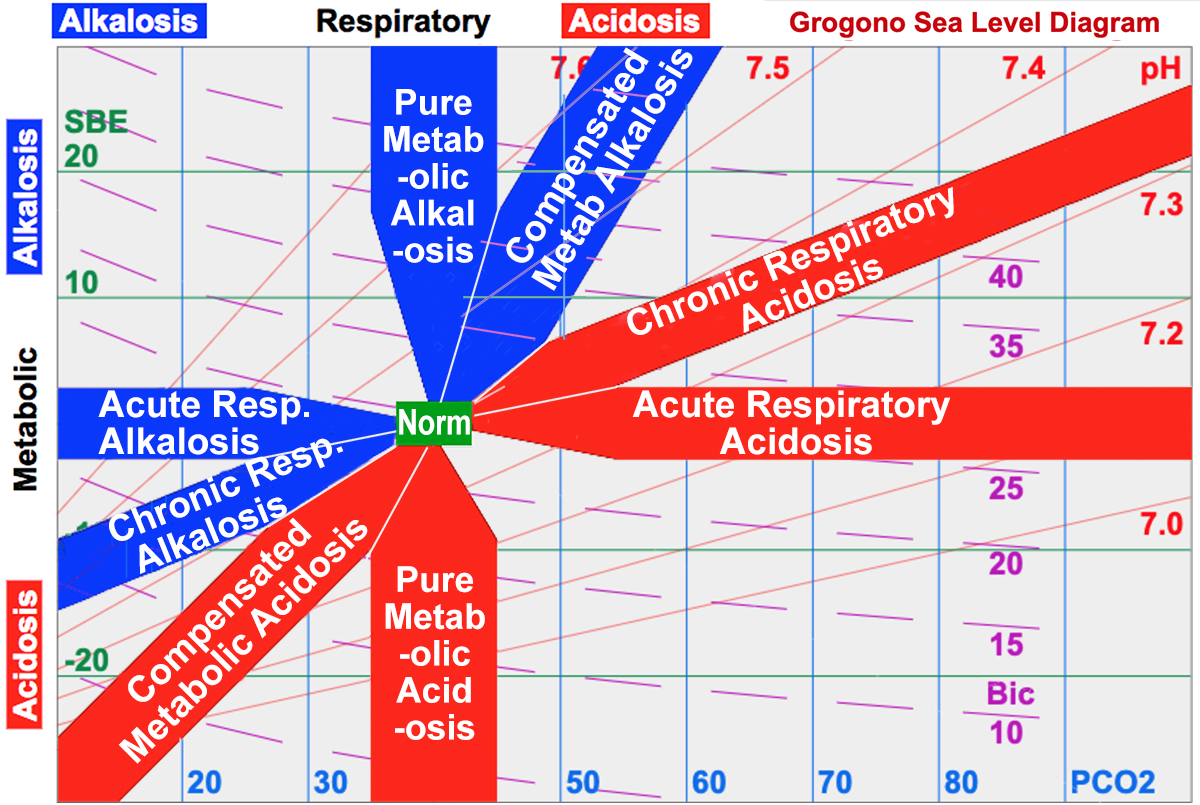
An interactive acid-base diagram is a major feature of this website. It allows numerical values to be visualized on an interactive diagram and simultaneously provides continuous text interpretation. The diagram operates in several modes allowing recognition of classical zones as well as self testing.
The mathematics and programming underlying the interactive diagrams and equations are described on separate pages. This site employs Java, Javascript, and Pop-Ups. To get the best out of this website, these must be active. If you have trouble with any combinations of computer and browser please Contact Me.
Please Contact me: I appreciate receiving your feedback. If you have ideas comments or suggestions, or if you find errors or spelling mistakes, please let me know. Thank you.
|
Peer-reviewed successfully by: MedEdPORTAL. Number: 402. Subsequent Revisions: Minor corrections only. |
Alan W. Grogono, MB, BS, MD(Lond), FRCA, Professor Emeritus Department of Anesthesiology, Tulane University. Until his retirement in 1988 he was the Jack Aron Professor and departmental chairman. For more information visit About the Author.
Please visit his other teaching websites: Animated Knots, Magic Squares, and Stereo Art.
|
Acid-Base Tutorial Alan W. Grogono |
Copyright Oct 2011. All Rights Reserved |